
The RBI's Alert List of unauthorised forex platforms
Key facts
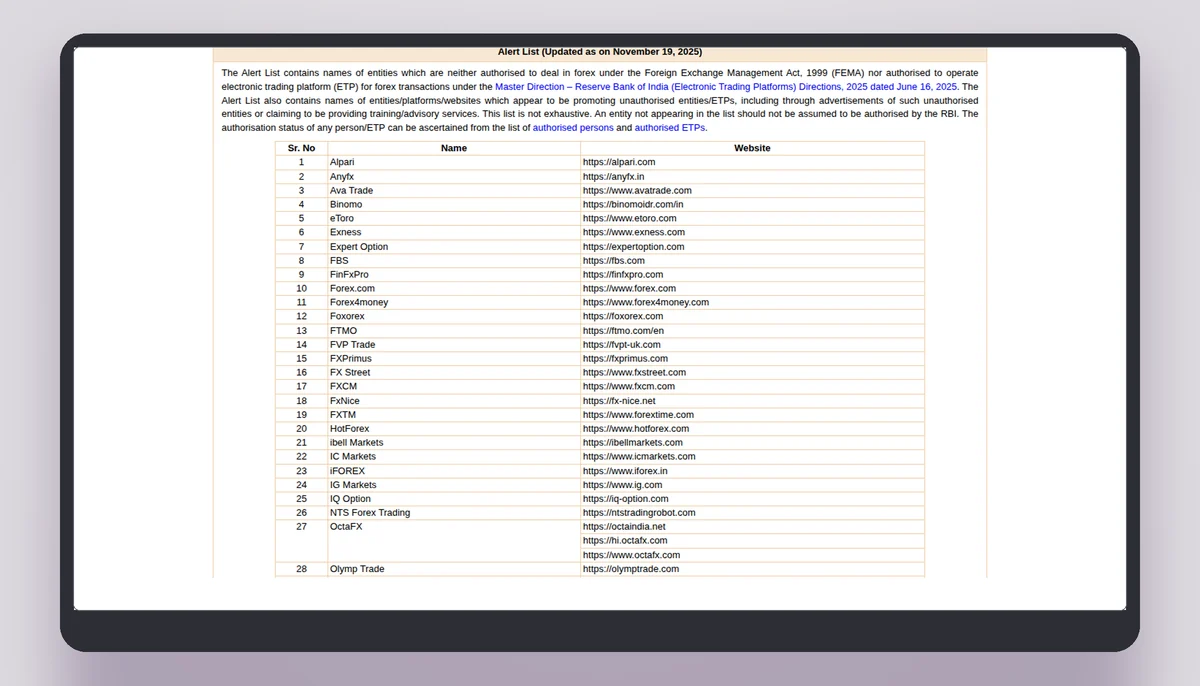
The Reserve Bank of India publishes an Alert List of entities and websites or apps it says are not authorised to offer forex trading to residents. The list is updated from time to time. The table above shows each entry by name, date, kind of notice and a link to the original. A row records what the Reserve Bank published, not a finding of ours.
RBI Alert List entries
The entity as the RBI lists it and the websites the RBI gives for it.
| Entity as the RBI listed it | Websites the RBI gives | Kind | Source |
|---|---|---|---|
| November 2025 | |||
| 2WinTrade | 2wintrade.com | On the RBI Alert List | RBI ↗ |
| Admiral Market | admiralmarkets.com | On the RBI Alert List | RBI ↗ |
| Alpari | alpari.com | On the RBI Alert List | RBI ↗ |
| Anyfx | anyfx.in | On the RBI Alert List | RBI ↗ |
| Ava Trade | avatrade.com | On the RBI Alert List | RBI ↗ |
| BD Swiss | global.bdswiss.com | On the RBI Alert List | RBI ↗ |
| Binomo | binomoidr.com | On the RBI Alert List | RBI ↗ |
| BlackBull | blackbull.com | On the RBI Alert List | RBI ↗ |
| Bric Trade | brictrade.com | On the RBI Alert List | RBI ↗ |
| Cabana Capitals | cabanacapitals.com | On the RBI Alert List | RBI ↗ |
| CapPlace | capplace.com | On the RBI Alert List | RBI ↗ |
| DBG Markets | dbgmarketsglobal.com | On the RBI Alert List | RBI ↗ |
| Dream Trade | Mobile Application | On the RBI Alert List | RBI ↗ |
| Easy Markets | easymarkets.com | On the RBI Alert List | RBI ↗ |
| Enclave FX | enclavefx.com | On the RBI Alert List | RBI ↗ |
| eToro | etoro.com | On the RBI Alert List | RBI ↗ |
| Exness | exness.com | On the RBI Alert List | RBI ↗ |
| Expert Option | expertoption.com | On the RBI Alert List | RBI ↗ |
| FBS | fbs.com | On the RBI Alert List | RBI ↗ |
| FinFxPro | finfxpro.com | On the RBI Alert List | RBI ↗ |
| Finowiz Fintech Limited | finowiz.com | On the RBI Alert List | RBI ↗ |
| Forex.com | forex.com | On the RBI Alert List | RBI ↗ |
| Forex4money | forex4money.com | On the RBI Alert List | RBI ↗ |
| Forex4you | forex4you.com | On the RBI Alert List | RBI ↗ |
| Foxorex | foxorex.com | On the RBI Alert List | RBI ↗ |
| FP Markets | fpmarkets.com | On the RBI Alert List | RBI ↗ |
| FreshForex | freshforex.com | On the RBI Alert List | RBI ↗ |
| FTMO | ftmo.com | On the RBI Alert List | RBI ↗ |
| FundedNext | fundednext.com | On the RBI Alert List | RBI ↗ |
| Fusion Markets | fusionmarkets.com | On the RBI Alert List | RBI ↗ |
| FVP Trade | fvpt-uk.com | On the RBI Alert List | RBI ↗ |
| FX Road | fxroad.com | On the RBI Alert List | RBI ↗ |
| FX SmartBull | fxsmartbull.com | On the RBI Alert List | RBI ↗ |
| FX Street | fxstreet.com | On the RBI Alert List | RBI ↗ |
| Fx Tray Market | fxtray.com | On the RBI Alert List | RBI ↗ |
| FX Western | fxwestern.com | On the RBI Alert List | RBI ↗ |
| FXCM | fxcm.com | On the RBI Alert List | RBI ↗ |
| FxNice | fx-nice.net | On the RBI Alert List | RBI ↗ |
| FXPrimus | fxprimus.com | On the RBI Alert List | RBI ↗ |
| FXTM | forextime.com | On the RBI Alert List | RBI ↗ |
| Gate Trade | Mobile Application | On the RBI Alert List | RBI ↗ |
| GoDo FX | godofx.com | On the RBI Alert List | RBI ↗ |
| Growing Capital Services Ltd. | growingcapital.uk | On the RBI Alert List | RBI ↗ |
| Growline | grow-line.org | On the RBI Alert List | RBI ↗ |
| Guru Trade7 Limited | gurutrade7.com | On the RBI Alert List | RBI ↗ |
| HF Markets | hfm.com | On the RBI Alert List | RBI ↗ |
| HotForex | hotforex.com | On the RBI Alert List | RBI ↗ |
| HYCM Capital Markets | hycm.com | On the RBI Alert List | RBI ↗ |
| ibell Markets | ibellmarkets.com | On the RBI Alert List | RBI ↗ |
| IC Markets | icmarkets.com | On the RBI Alert List | RBI ↗ |
| iFOREX | iforex.in | On the RBI Alert List | RBI ↗ |
| IG Markets | ig.com | On the RBI Alert List | RBI ↗ |
| Inefex | inefex.com | On the RBI Alert List | RBI ↗ |
| Infinox | infinox.com | On the RBI Alert List | RBI ↗ |
| IQ Option | iq-option.com | On the RBI Alert List | RBI ↗ |
| Iron Fx | ironfx.com | On the RBI Alert List | RBI ↗ |
| JGCFX | jgcfx.com | On the RBI Alert List | RBI ↗ |
| Just Markets | justmarkets.com | On the RBI Alert List | RBI ↗ |
| MetaTrader 4 | metatrader4.com | On the RBI Alert List | RBI ↗ |
| MetaTrader 5 | metatrader5.com | On the RBI Alert List | RBI ↗ |
| Mini Trade | Mobile Application | On the RBI Alert List | RBI ↗ |
| Mirrox | mirrox.com | On the RBI Alert List | RBI ↗ |
| Nord FX | nordfx.com | On the RBI Alert List | RBI ↗ |
| NTS Forex Trading | ntstradingrobot.com | On the RBI Alert List | RBI ↗ |
| NXG Markets | nxgmarkets.com | On the RBI Alert List | RBI ↗ |
| OctaFX | octaindia.net / hi.octafx.com / octafx.com | On the RBI Alert List | RBI ↗ |
| Olymp Trade | olymptrade.com | On the RBI Alert List | RBI ↗ |
| Pepperstone | pepperstone.com | On the RBI Alert List | RBI ↗ |
| Plusonetrade | plusonetrade.com | On the RBI Alert List | RBI ↗ |
| Pocket Option | pocketoption.com | On the RBI Alert List | RBI ↗ |
| PU Prime | in.puprime.com | On the RBI Alert List | RBI ↗ |
| QFX Markets | qfxmarkets.com | On the RBI Alert List | RBI ↗ |
| Quotex | quotex.com | On the RBI Alert List | RBI ↗ |
| Ranger Capital | rangercapital.net | On the RBI Alert List | RBI ↗ |
| Real Gold Capital Ltd. | realgoldcapitals.com | On the RBI Alert List | RBI ↗ |
| Rubik Trade | rubiktrade.com | On the RBI Alert List | RBI ↗ |
| Smart Prop Trader | smartproptrader.com | On the RBI Alert List | RBI ↗ |
| Starnet FX | starnetfx.com | On the RBI Alert List | RBI ↗ |
| TD Ameritrade | tdameritrade.com | On the RBI Alert List | RBI ↗ |
| TDFX | tdfx.exchange | On the RBI Alert List | RBI ↗ |
| Think Markets | thinkmarkets.com | On the RBI Alert List | RBI ↗ |
| Tickmill | tickmill.com | On the RBI Alert List | RBI ↗ |
| TNFX | tnfx.co | On the RBI Alert List | RBI ↗ |
| TP Global FX | tpglobalfx.com | On the RBI Alert List | RBI ↗ |
| Trade Sight FX | tradesightfx.co.in | On the RBI Alert List | RBI ↗ |
| Trive | trive.com | On the RBI Alert List | RBI ↗ |
| Trust Trade | Mobile Application | On the RBI Alert List | RBI ↗ |
| Urban Forex | urbanforex.com | On the RBI Alert List | RBI ↗ |
| Vantage Markets | vantagemarkets.com | On the RBI Alert List | RBI ↗ |
| VT Markets | vtmarkets.com | On the RBI Alert List | RBI ↗ |
| Weltrade | weltrade.com | On the RBI Alert List | RBI ↗ |
| XM | xm.com | On the RBI Alert List | RBI ↗ |
| XTB | xtb.com | On the RBI Alert List | RBI ↗ |
| Ya Markets | yamarkets.com | On the RBI Alert List | RBI ↗ |
| YorkerFX | yorkermarkets.com | On the RBI Alert List | RBI ↗ |
What the Alert List is
The Alert List is a list of entities, websites and apps that the Reserve Bank says are not authorised under the Foreign Exchange Management Act to deal in forex or to operate electronic trading platforms for forex. The list is published on the Reserve Bank's website and updated from time to time.
The list is not a list of authorised platforms. Absence from the list is not evidence that a platform is authorised. The list is only a warning that the named entities are not authorised.
What the table above shows
The table above is read from the Alert List that the Reserve Bank publishes. Each row shows the name exactly as the source wrote it, the websites the Reserve Bank gives for it, the kind of notice, and a link to the original. The list carries one date for all its entries, the one the Reserve Bank gives; it is shown above the rows.
A row records what the source published, not a finding of ours. This site does not say that the named entity is a fraud or a scam. It says only that the Reserve Bank has published an alert about it on that date.
The permitted route for resident forex trading
The Reserve Bank's position is that residents may trade forex only on recognised exchanges in specified currency pairs involving the rupee. This means trading through a recognised Indian exchange, not through an overseas platform. The permitted pairs are set out in the exchange's contract specifications.
Any other route, including a margin trade through an overseas app, is outside what the law allows a resident. The Reserve Bank's Alert List names platforms that it says offer such unauthorised trading. A resident who uses such a platform may be in breach of the foreign exchange law.
Why a platform is on the list
The Reserve Bank places an entity on the Alert List when it finds that the entity is offering forex trading to residents without authorisation. The entity may be based overseas, and its website or app may be accessible from India. The Reserve Bank's statement is that the entity is not authorised.
The list does not say that the entity is a fraud. It says only that the entity is not authorised under the law. The reader should treat the listing as a warning to stay away from that platform.
What the list does not tell you
The list does not say that the platform is unsafe in a technical sense. It does not say that investors have lost money. It does not say that the platform will be prosecuted. It says only that the platform is not authorised to offer forex trading to residents.
The list also does not say that a platform is authorised if it is not on the list. The only way to know if a platform is authorised is to check with the Reserve Bank or an authorised bank.
How to use the table
The table above is a list of alerts, not a list of all unauthorised platforms. The Reserve Bank may have published alerts that are not in this table if this site's weekly read missed them or if the Reserve Bank removed them. The table is a record of what the Reserve Bank published.
To use the table, look for the name of a platform you are considering. If it appears, read the kind of notice to see what the Reserve Bank says. Then click the link to read the original alert on the Reserve Bank's website.
A resident cannot use borrowed rupees to trade currency on an overseas app
The foreign exchange law permits a resident to deal in foreign exchange only for the purposes that the law itself recognises. Currency trading for speculative gain is not one of those purposes, so a resident cannot use an overseas platform to buy and sell currency pairs against the rupee or against other currencies. The platform may present the trade as a contract for difference or as a margin trade, but the label does not change the legal position.
When an app accepts a rupee deposit and then lets a user take a leveraged position in a currency pair, the user is effectively borrowing rupees to take a foreign exchange exposure. That is exactly what the law does not permit outside the route that the Reserve Bank has prescribed. The platform may hold the margin in an overseas account or convert it at the time of the trade, but the resident's act of sending the money abroad for that purpose is itself a contravention.
The consequence falls on the resident, not on the platform. The platform may be outside the reach of Indian enforcement, but the resident's bank account, PAN and passport are all within it. A remittance that is later traced to an unauthorised forex platform can lead to a penalty under the foreign exchange law, even if the platform was the one that solicited the trade.
An overseas platform can still take your money even when it is on the Alert List
The Alert List does not block a website or stop an app from being downloaded in India. It records that the Reserve Bank has found the entity to be offering forex trading to residents without the authorisation that the law requires. The platform can continue to advertise, accept deposits and show a live price feed to a user in India after its name appears on the list.
A resident who sends money to a listed platform is not protected by the fact that the Reserve Bank has warned about it. The bank that processes the remittance may flag it, but the platform can still use payment aggregators, informal channels or cryptocurrency to receive funds. The Alert List is a notice to the public, not a technical block, and it does not freeze the platform's accounts or stop it from onboarding new users.
When a platform is on the list, the practical risk to a resident rises rather than falls. The platform knows that its access to formal banking channels may be cut off at any time, so it has an incentive to delay withdrawals or demand additional payments before releasing funds. A user who continues to trade after the listing cannot claim ignorance of the regulator's position.
The bank that sends your money overseas also has a duty under the law
A resident cannot send money abroad for a forex trade simply by asking a bank to make the transfer. The bank is required to check the purpose of the remittance against the categories that the foreign exchange law permits. If the resident declares a false purpose, such as travel or education, the bank may process the transfer, but the resident has then made a misrepresentation to an authorised dealer.
When a bank processes a remittance and later learns that the funds went to an unauthorised forex platform, the bank itself can be penalised by the Reserve Bank. The bank is expected to know its customer's transaction pattern and to question a remittance that does not fit the declared purpose. A sudden transfer to a trading account in an offshore jurisdiction is one such pattern.
The practical effect is that a resident who tries to fund an overseas forex account may find the remittance blocked or returned. The bank may ask for proof of the purpose, and a resident who cannot provide it will not be able to send the money. This is not a customer service failure; it is the bank complying with its own obligations under the foreign exchange law.
The cost of an unauthorised forex trade is not the spread the platform shows
A resident who trades forex on an overseas app sees a bid and an ask price, and the difference between them looks like the cost of the trade. But the real cost includes the margin that the platform takes on the currency conversion when the resident deposits rupees and later withdraws them. That conversion rate is set by the platform, not by the market, and it can move against the resident even when the currency pair itself has not moved.
On top of the conversion cost, the platform may charge a withdrawal fee, an inactivity fee or a rollover fee for holding a position overnight. These charges are often deducted from the account balance without a separate invoice, so the resident does not see them as a cost of trading. They accumulate in the background and reduce the amount that can be withdrawn.
When the platform is unauthorised, the resident has no recourse to the Reserve Bank's customer grievance mechanism for authorised dealers. The platform's terms of service may specify arbitration in a foreign jurisdiction, which is prohibitively expensive for a retail trader. The cost of the trade, in other words, includes the loss of any enforceable right to get the money back.
The only legal way for a resident to trade currency is through a recognised exchange
The foreign exchange law allows a resident to trade in currency derivatives only on an exchange that the Reserve Bank has recognised for that purpose. The recognised exchanges are Indian entities, and the contracts they offer are standardised and settled in rupees. A resident who wants to take a view on a currency pair can do so through a broker registered with SEBI, using the exchange-traded currency derivatives segment.
This route does not involve sending money abroad. The margin is held in India, the contract is settled in rupees, and the broker is answerable to Indian regulators. The range of currency pairs is limited to those that the exchange offers, and the contract sizes are fixed, so a resident cannot take a bespoke position like the one an overseas platform might advertise.
A resident who trades through an overseas app is not doing the same thing as a resident who trades on a recognised exchange. One is a regulated domestic transaction; the other is an overseas remittance for a purpose the law does not permit. The distinction matters because the first has a clear legal basis and the second does not, regardless of what the platform's marketing says.
What a resident can still do through an authorised dealer
The foreign exchange law does not stop every cross-border payment, but it does channel most of them through an authorised dealer. A resident can send money abroad for permitted current account transactions such as education, medical treatment, or family maintenance, subject to the limits set by the Reserve Bank. A resident can also hold and trade foreign currency through a bank account opened with an authorised dealer, but only within the rules for that account. The key distinction is that the resident deals with a bank or a regulated financial institution, not with an overseas platform that promises leveraged trading.
For currency derivatives, the permitted venues are the recognised exchanges in India. A resident can trade currency futures and options on exchanges that the Securities and Exchange Board of India and the Reserve Bank have approved for that purpose. These contracts are standardised, settled through clearing corporations, and subject to Indian margin rules. The counterparty is the exchange, not an unknown entity abroad. If a platform invites a resident to trade currency pairs outside these exchanges, the route is not the one the law permits.
The practical consequence of using only authorised dealers and recognised exchanges is that the resident remains within the protection of Indian regulators. Disputes can go to Indian courts and grievance mechanisms. The resident knows who holds the margin and how it is protected. An overseas platform may offer more leverage or more currency pairs, but it operates outside that framework. The resident who uses it cannot rely on the same safeguards if the platform fails or refuses to return funds.
Read next
What users of trading apps ask
What is the RBI Alert List?
It is a list of entities and websites or apps that the Reserve Bank says are not authorised to offer forex trading to residents. It is updated from time to time on the Reserve Bank's website.
Does being on the list mean the platform is a fraud?
No. It means the platform is not authorised under the foreign exchange law. The Reserve Bank does not say that the platform is a fraud. It says only that it is not authorised.
Can residents trade forex through an overseas platform?
No. The Reserve Bank's position is that residents may trade forex only on recognised exchanges in specified currency pairs involving the rupee. Trading through an overseas platform is not allowed.
How often is the table updated?
The table is read once a week from the Reserve Bank's website. The date shown is the date the Reserve Bank published or updated the alert.
Is a platform safe if it is not on the list?
No. Absence from the list is not evidence that a platform is authorised. The list is not a whitelist. To know if a platform is authorised, check with the Reserve Bank or an authorised bank.
What opening an account with an international broker means
The account this site links to is with FxPro, an international broker offering CFDs on currencies, metals, indices, shares and crypto. A CFD is an agreement on a price; no asset is delivered. CFDs are leveraged and carry a high risk of losing the money deposited. Before opening an account from India, check the current rules on remittance with an authorised bank.