
Where to complain
Key facts
If you have a complaint about a registered entity, a regulated entity, a cyber fraud or a payment, there are channels to turn to. This page lists them and says what to bring. It does not promise recovery.
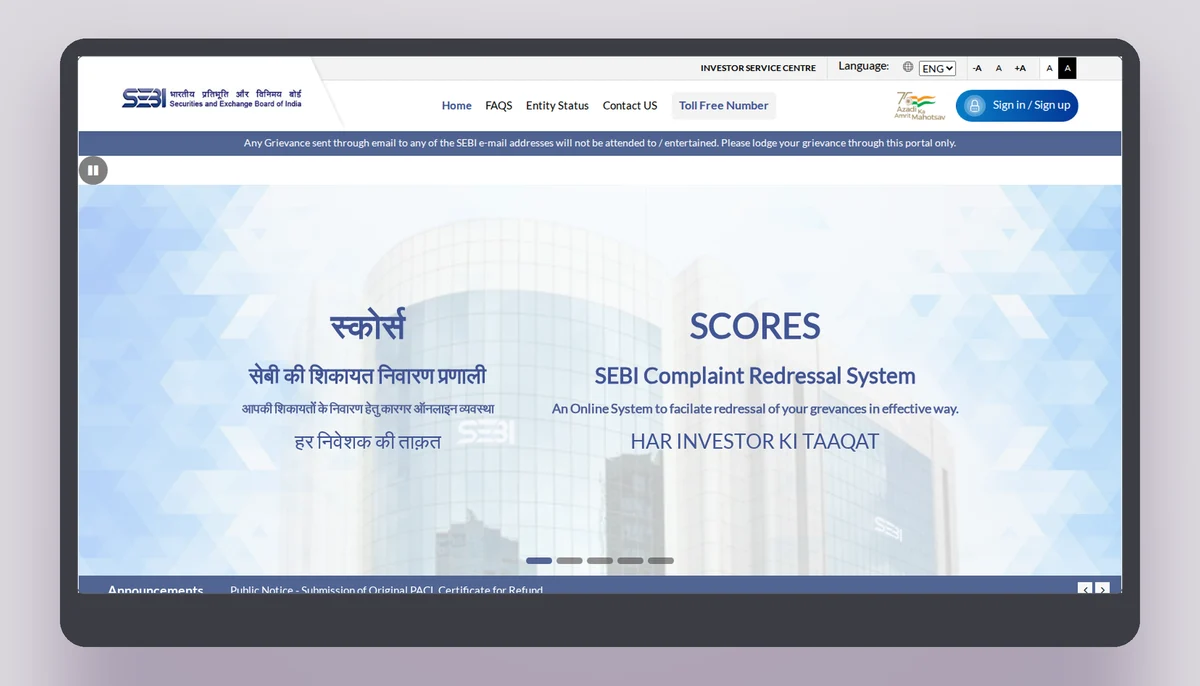
SEBI's SCORES portal
SCORES is SEBI's online complaint portal for complaints against registered entities: stockbrokers, investment advisers, research analysts and others. You can file a complaint if you have a dispute with a registered entity about its services.
To file, you need to register on the SCORES portal and provide details of the complaint, including the name of the entity, the registration number if you have it, and the documents supporting your complaint. SCORES does not handle complaints about unregistered entities.
The RBI's complaint portal
The Reserve Bank has a complaint portal for complaints against regulated entities: banks, non-banking financial companies and payment system operators. If your complaint is about a bank's refusal to process a remittance, or about a payment system, this is the channel.
The portal requires details of the entity and the complaint. The Reserve Bank does not handle complaints about unauthorised forex platforms; those are a matter for the cybercrime authorities.
The national cybercrime reporting portal
The national cybercrime reporting portal is run by the Ministry of Home Affairs. It is the channel for reporting cyber fraud, including fraud by an unregistered app, a bot or an unauthorised forex platform. You can report online or through the cybercrime helpline.
To report, you need details of the incident: the name of the app or platform, the website or app store link, the payments made, and the communication you had. The portal does not promise recovery, but it is the first step for a fraud investigation.
Your bank for a payment made
If you have made a payment to an app or platform, your bank is the first point of contact. The bank may be able to stop a pending payment or to reverse a completed one in some cases. The bank can also block future payments to the same payee.
To contact the bank, have the transaction details ready: the date, the amount, the payee name and the reference number. The bank's customer service can guide you on the next steps. The bank is not responsible for your loss, but it can help you stop further loss.
What to bring
For any complaint, bring the same set of records: the name of the entity, the app or website, the communication you had, the payments made and the dates. Keep screenshots, emails, payment receipts and bank statements.
The records are the evidence for your complaint. Without them, the complaint is harder to process. Organise them before you file.
What not to expect
None of these channels promise recovery. A complaint may lead to an investigation, a penalty on the entity, or a refund in some cases, but not always. The process takes time, and the outcome is uncertain.
The best protection is to check before you pay. This site teaches the checks: the SEBI cautions, the RBI Alert List and the registered intermediary list. Use them before you send money.
A complaint about a registered intermediary goes to the exchange first
When a stock broker or a depository participant is registered with SEBI, the first place to raise a dispute is the exchange or depository where the trade or holding sits. The exchange has a grievance cell that forwards the complaint to the member and tracks the reply. This route is faster than SEBI because the member has a deadline to respond, and the exchange can levy fines if the reply is late.
The complaint should be filed on the exchange's own portal, not on SCORES, if the matter is about trade execution, margin, pay-out of funds or securities, or account closure. Each exchange keeps a separate login for investors, and the complaint needs the client ID and the trade date. Without those details, the exchange will return the complaint as incomplete.
A complaint to the exchange is not the same as an arbitration claim. If the reply is unsatisfactory or the member does not act, the exchange offers a conciliation and then an arbitration mechanism under its bye-laws. The arbitration award is binding, but the investor has to file the claim within the period set by the exchange.
A payment fraud has a time-sensitive reporting order
For a cyber fraud or an unauthorised debit, the first call is to the bank that issued the card or holds the account. The bank can freeze the destination account if it is in the same bank, or put a lien on the amount if it is in another bank. The Reserve Bank's framework makes the bank responsible for acting on the customer's report without waiting for a police complaint.
The national cybercrime reporting portal accepts a complaint online, but the bank's action has to start before that. The portal gives an acknowledgement number that helps with the bank, and the bank can use it to escalate the matter with the destination bank. A delay between the debit and the report reduces the chance of recovering the money because the fraudster moves it out quickly.
The bank may ask for a written confirmation of the complaint, and the customer should keep a record of the time of the call, the name of the officer, and the reference number. If the bank does not act, the customer can approach the banking ombudsman, but the ombudsman will first ask whether the bank was given a chance to stop the payment.
A complaint to the RBI about a forex platform follows a different channel
The RBI's Alert List names platforms that are not authorised to deal in foreign exchange under the Foreign Exchange Management Act. A user who has paid money to such a platform can complain to the RBI, but the complaint will not lead to a refund. The RBI's role is to record the name and to alert the enforcement agencies, not to recover funds from an overseas entity.
The complaint should be sent to the RBI's central office or to the regional office, with details of the platform, the amount, the date of transfer, and the bank through which the money went. The RBI will not ask the platform to return the money, and the user should not expect the RBI to act as a collection agent. The complaint adds to the regulator's information about the platform.
A separate complaint to the bank that executed the transfer is needed because the bank may have failed to check whether the payment was for a permitted purpose. The bank is responsible for ensuring that outward remittances comply with the foreign exchange law, and a complaint to the bank can trigger an internal review of the transaction.
A complaint about an unregistered adviser starts with SEBI's SCORES, but only for a registered entity
SCORES is the portal for complaints against entities that SEBI regulates, such as brokers, advisers, and portfolio managers. If an entity is not registered with SEBI, a complaint on SCORES will be closed with a note that the entity is outside SEBI's jurisdiction. The user then has to go to the police or to the cybercrime portal because SEBI cannot recover money from an unregistered person.
The complaint about an unregistered adviser can be sent to SEBI's information desk, but that is not a formal complaint. SEBI may use the information to issue a caution or to start an investigation, but the user will not get a reply about the action taken. The caution on SEBI's website is the only public record that the user will see.
If the user has lost money to an unregistered adviser, the police complaint is the primary route. The police can investigate under the Indian Penal Code for cheating or under the information technology law for online fraud. The user should bring the SEBI caution as evidence that the entity was not registered, but the caution alone does not prove that a crime was committed.
A complaint about a bank's conduct goes to the banking ombudsman after the bank's internal process
The banking ombudsman is a quasi-judicial authority under the Reserve Bank, and it can hear complaints about a bank's deficiency in service. Before going to the ombudsman, the customer has to lodge a complaint with the bank and wait for the bank's reply or for the time limit to lapse. The ombudsman will not take a complaint that is already pending in a court or before another authority.
The ombudsman can award compensation for the loss suffered, but the amount is capped by the scheme. The award is binding on the bank if the customer accepts it, and the customer can reject it and go to court. The process is free and does not need a lawyer, but the customer has to file within the period set by the scheme.
A complaint about a payment made to an unauthorised forex platform is a deficiency in service if the bank did not check the purpose of the remittance. The ombudsman can direct the bank to compensate the customer if the bank failed to follow the foreign exchange rules, but the ombudsman cannot order the platform to return the money.
A complaint to the police for a cyber fraud needs a specific format
The police station that has jurisdiction is the one where the victim resides or where the money was debited, not where the platform is located. The complaint should be in writing, with the details of the transaction, the bank statement, and the communication with the platform. The police will register a first information report if the facts show a cognisable offence, such as cheating or identity theft.
The national cybercrime reporting portal is an alternative to going to the police station, and it is available for all states. The portal asks for the same details and gives an acknowledgement number that can be used to track the complaint. The portal does not replace the police investigation, but it ensures that the complaint is recorded in the central database.
The police can freeze the bank accounts of the fraudster if the money is still in the account, and they can ask the bank to reverse the transaction. The police cannot act against an overseas platform directly, but they can use the mutual legal assistance treaty to seek information from the foreign country. The process is slow, and the victim should not expect a quick recovery.
A complaint about a trading bot or a signal app goes to SEBI only if the entity is registered
A trading bot that gives buy or sell calls is acting as an investment adviser, and if it is not registered with SEBI, a complaint about it will not be accepted on SCORES. The user can send the details to SEBI's information desk, but SEBI will not reply with the action taken. The user should also complain to the app store where the bot was downloaded, because the app store can remove the app for misleading claims.
The cost of a wrong signal is not just the loss on the trade. The user may have paid a subscription fee for the bot, and the bot may have taken a cut of the trading volume through a referral arrangement with a broker. A complaint to the broker is needed if the broker allowed the bot to operate on its platform without checking the registration, because the broker is responsible for the third-party services it allows.
If the user has lost money to a bot, the police complaint is the primary route, and the user should bring the SEBI caution about unregistered bots as evidence. The caution shows that SEBI has warned about such services, but it does not prove that the bot defrauded the user. The police will investigate the facts of the case, not the regulatory status of the bot.
Read next
What users of trading apps ask
Where do I complain about a registered stockbroker?
Use SEBI's SCORES portal. It handles complaints against registered entities. You need to register on the portal and provide details of the complaint and the supporting documents.
Where do I complain about a bank?
Use the RBI's complaint portal. It handles complaints against regulated entities such as banks and payment system operators. Provide details of the entity and the complaint.
Where do I report a cyber fraud?
Use the national cybercrime reporting portal or the cybercrime helpline. It is the channel for reporting fraud by an unregistered app, a bot or an unauthorised forex platform.
What should I bring to a complaint?
Bring the same set of records: the name of the entity, the communication, the payments made and the dates. Keep screenshots, emails, payment receipts and bank statements.
Will I get my money back?
There is no promise of recovery. A complaint may lead to an investigation or a refund in some cases, but not always. The process takes time and the outcome is uncertain.
What opening an account with an international broker means
The account this site links to is with FxPro, an international broker offering CFDs on currencies, metals, indices, shares and crypto. A CFD is an agreement on a price; no asset is delivered. CFDs are leveraged and carry a high risk of losing the money deposited. Before opening an account from India, check the current rules on remittance with an authorised bank.