
Forex trading under the foreign exchange law
Key facts
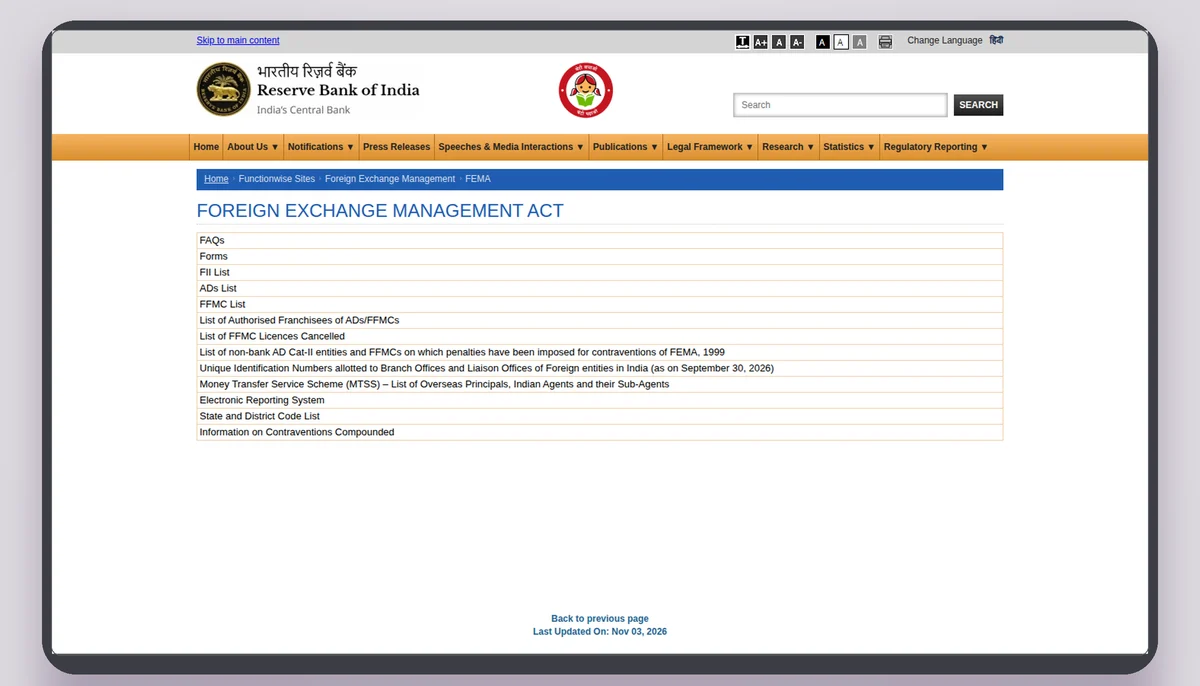
The foreign exchange law, FEMA, sets out what residents may and may not do with foreign exchange. The Reserve Bank's published position is that residents may trade forex only on recognised exchanges in specified currency pairs involving the rupee. Remittance under the Liberalised Remittance Scheme is not allowed for margin on such trading. This page states the rule in general terms and tells you to confirm with an authorised bank.
The general position
The Reserve Bank's position is that a resident may trade forex only on a recognised Indian exchange, in specified currency pairs involving the rupee. The permitted pairs are set out in the exchange's contract specifications. Trading through an overseas platform is not allowed.
This is the rule as the Reserve Bank publishes it. It applies to all residents, whether they are trading for themselves or through an app. The rule does not depend on the size of the trade or the platform used.
What 'recognised exchange' means
A recognised exchange is an exchange that is recognised by the Securities and Exchange Board of India. The recognised exchanges for forex trading in India are the National Stock Exchange, the Bombay Stock Exchange and the Metropolitan Stock Exchange. They offer futures and options on rupee pairs.
The currency pairs are specified by the exchange and approved by the Reserve Bank. They always involve the rupee on one side. A pair that does not involve the rupee is not permitted.
Why overseas platforms are not allowed
An overseas platform offers trading in currency pairs that may not involve the rupee. It may also offer margin trading, which is not allowed under the Liberalised Remittance Scheme. The Reserve Bank says that remittance under the scheme is not allowed for margin on forex trading.
The platform may be well-designed and may offer better prices, but it is outside the law. A resident who uses such a platform may be in breach of the foreign exchange law.
The Liberalised Remittance Scheme
The Liberalised Remittance Scheme allows a resident to send money abroad for permitted purposes, such as education, travel or medical treatment. The scheme does not allow remittance for margin trading in forex or leveraged derivatives overseas.
The scheme has a limit, but this page does not state it because it changes. The reader should confirm the current limit and the current list of permitted purposes with an authorised bank.
What to ask an authorised bank
An authorised bank is a bank that is authorised by the Reserve Bank to deal in foreign exchange. The bank can tell you whether a particular remittance is allowed under the scheme. It can also tell you the current limit and the documentation required.
Before sending any money to an overseas platform, ask the bank: is this remittance allowed? The bank's answer is the one that matters. If the bank refuses, the remittance is not allowed.
The consequences of getting it wrong
If a resident sends money abroad for a purpose that is not allowed, the bank may refuse the remittance. The resident may also face penalties under the foreign exchange law. The penalties can be heavy.
The Reserve Bank publishes the Alert List of unauthorised platforms to warn residents. A platform on that list is a clear signal that the platform is not authorised. But absence from the list is not evidence that a platform is authorised.
A resident can trade only in currency pairs the exchange lists
The permitted rupee pairs are fixed by the recognised exchanges. A resident cannot add a new pair by using an overseas platform and then argue that the underlying currencies are the same. The exchange's contract list is the boundary, not a suggestion. When a platform offers a pair that is not on that list, the trade is outside the permitted route before any money changes hands.
The practical consequence is that a resident who wants exposure to a currency that is not paired with the rupee has no legal way to get it through a margin trade. They can hold a foreign currency account within the rules set by the authorised bank, but they cannot use that account to place leveraged bets on exchange movements. The distinction is between holding currency and trading it.
Many readers confuse the existence of a pair on a global market with permission to trade it from India. The law does not care what pairs exist elsewhere. It cares what the Indian exchanges have been allowed to list and what the authorised banks are allowed to settle. Anything outside that list falls back to the general prohibition on resident margin trading.
An overseas platform cannot ask an Indian bank to settle a margin trade
When a resident places a margin trade on an overseas platform, the platform eventually needs to move money back into the resident's Indian bank account. That movement is the point where the authorised bank must apply the foreign exchange rules. The bank will not process a credit that is identified as the proceeds of a leveraged currency trade by a resident, because the bank itself would be facilitating an unauthorised transaction.
The platform may try to split the payment or label it as something else, such as a refund or a business payment. The authorised bank's compliance team is required to look through the label and ask for the underlying transaction. If the underlying transaction is a margin trade, the bank has to refuse the credit. The resident's money can get stuck in the platform's wallet with no lawful way to bring it back.
This is the practical failure mode that the RBI's Alert List is designed to prevent. The platform may be willing to accept the trade, and the resident may be willing to place it, but the Indian banking channel is the choke point. No amount of clever wording on the payment instruction changes the nature of the transaction that the bank is being asked to settle.
The Liberalised Remittance Scheme does not permit margin trading
Residents sometimes assume that the money they are allowed to remit abroad under the Liberalised Remittance Scheme can be used for any purpose once it leaves India. That assumption is wrong for margin trading. The scheme permits a set of current account transactions, but it explicitly does not permit remittances for margin trading or for trading in foreign exchange overseas.
The consequence is that even if a resident has unused remittance allowance, they cannot lawfully use that allowance to fund an account on an overseas forex platform. The authorised bank will ask for the purpose of the remittance. If the resident says it is for margin trading, the bank must refuse. If the resident says it is for something else and then uses it for margin trading, the resident has made a false declaration to the bank.
The false declaration carries its own consequences under the foreign exchange law, separate from the unauthorised trade itself. The bank may close the resident's account, report the transaction to the RBI, and the resident may face a penalty. The remittance allowance is not a licence to bypass the prohibition on resident forex trading.
The penalty is calculated on the amount involved, not on the profit or loss
When a resident is found to have contravened the foreign exchange law by trading on an overseas platform, the penalty is not limited to the profit they made or the loss they suffered. The law allows the adjudicating authority to impose a penalty up to three times the sum involved in the contravention. The sum involved is the gross amount of the transactions, not the net position.
A resident who made many small trades over a year can find that the sum involved is the total value of all those trades added together. The penalty can therefore be far larger than the money the resident actually deposited with the platform. This is the order of operations that readers often get wrong: they think of the penalty as a percentage of their deposit, but the law looks at the turnover.
The practical consequence is that a resident who traded frequently, even with small amounts, faces a much larger exposure than a resident who made one large trade. The adjudicating authority also has the power to confiscate the amount involved. The resident's loss on the trades does not reduce the penalty; it may even increase the sum involved if the resident traded more to recover the loss.
A platform's claim of being regulated abroad is irrelevant to the Indian rules
Overseas platforms often display a licence from a foreign regulator. That licence may be genuine, but it does not authorise the platform to offer margin trading to residents of India. The foreign regulator's permission is limited to the platform's home jurisdiction. The Indian foreign exchange law applies to the resident, not to the platform, and the resident cannot use a foreign licence as a defence.
The consequence is that a resident who checks the platform's foreign registration and finds it valid may still be contravening the Indian law by trading. The platform may be fully compliant with its home regulator and still be on the RBI's Alert List because the RBI's concern is not the platform's conduct abroad but the resident's conduct in India.
This distinction is one that readers often get wrong. They assume that a regulated platform is safe to use from India. The correct question is not whether the platform is regulated somewhere, but whether the transaction is permitted for a resident under the Indian foreign exchange law. The two questions are independent.
The resident's bank can ask for the source of every inward remittance
When money comes back into a resident's account from an overseas platform, the authorised bank is required to ask for the source and purpose of the remittance. The bank cannot simply credit the money and remain silent. If the resident cannot provide a satisfactory explanation, the bank may freeze the funds, return the remittance, or report the transaction to the RBI.
The practical failure mode is that the resident may have made a profit on the platform but cannot bring the profit back without triggering the bank's questions. The bank may ask for the platform's contract note, the trade history, and the source of the initial remittance. If those documents show a margin trade, the bank must refuse the credit and report the matter.
The resident is then in a worse position than if they had never traded. The profit is stuck overseas, the bank has a record of the attempted transaction, and the RBI may initiate an inquiry. The resident cannot argue that the bank should have warned them earlier; the bank's duty to ask arises at the time of the credit.
The RBI's Alert List is updated without notice to the platforms or the users
The RBI adds names to its Alert List based on its own monitoring and on references from banks and other agencies. The platforms are not given advance notice, and the users are not warned individually. The list can change between two visits to the RBI's website, and a platform that was not on the list yesterday may be on it today.
The consequence is that a resident who checks the list once and then trades for several months may be trading on a platform that has since been added. The check is only as good as the date it was made. The resident cannot claim that they relied on the absence of the name from an earlier version of the list.
The only safe order of operations is to check the list immediately before each transaction and to keep a record of the check. Even that does not make the platform safe; it only tells the resident whether the RBI had named the platform at that moment. The RBI's list is a warning, not a clearance.
Read next
What users of trading apps ask
Can residents trade forex on an overseas platform?
No. The Reserve Bank's position is that residents may trade forex only on recognised exchanges in specified currency pairs involving the rupee. Trading through an overseas platform is not allowed.
What is a recognised exchange?
A recognised exchange is an exchange recognised by SEBI. The recognised exchanges for forex trading in India are the NSE, BSE and MSE. They offer futures and options on rupee pairs.
Is remittance allowed for margin trading?
No. The Liberalised Remittance Scheme does not allow remittance for margin trading in forex or leveraged derivatives overseas. The reader should confirm the current rules with an authorised bank.
What is the limit under the Liberalised Remittance Scheme?
The limit changes from time to time. This page does not state it. The reader should ask an authorised bank for the current limit.
What happens if I use an unauthorised platform?
The bank may refuse the remittance. The resident may also face penalties under the foreign exchange law. The Reserve Bank publishes an Alert List of unauthorised platforms to warn residents.
What opening an account with an international broker means
The account this site links to is with FxPro, an international broker offering CFDs on currencies, metals, indices, shares and crypto. A CFD is an agreement on a price; no asset is delivered. CFDs are leveraged and carry a high risk of losing the money deposited. Before opening an account from India, check the current rules on remittance with an authorised bank.