
A plain guide to what SEBI and RBI publish about trading apps, bots and forex platforms.
India's two financial regulators publish cautions and lists about unregistered advisers, AI trading bots, signal apps and unauthorised forex platforms. This site puts both lists in dated tables and teaches the rule behind each one. Nothing here rates an app; a listing is the regulator's act, and the reader decides.
Three routes into the subject
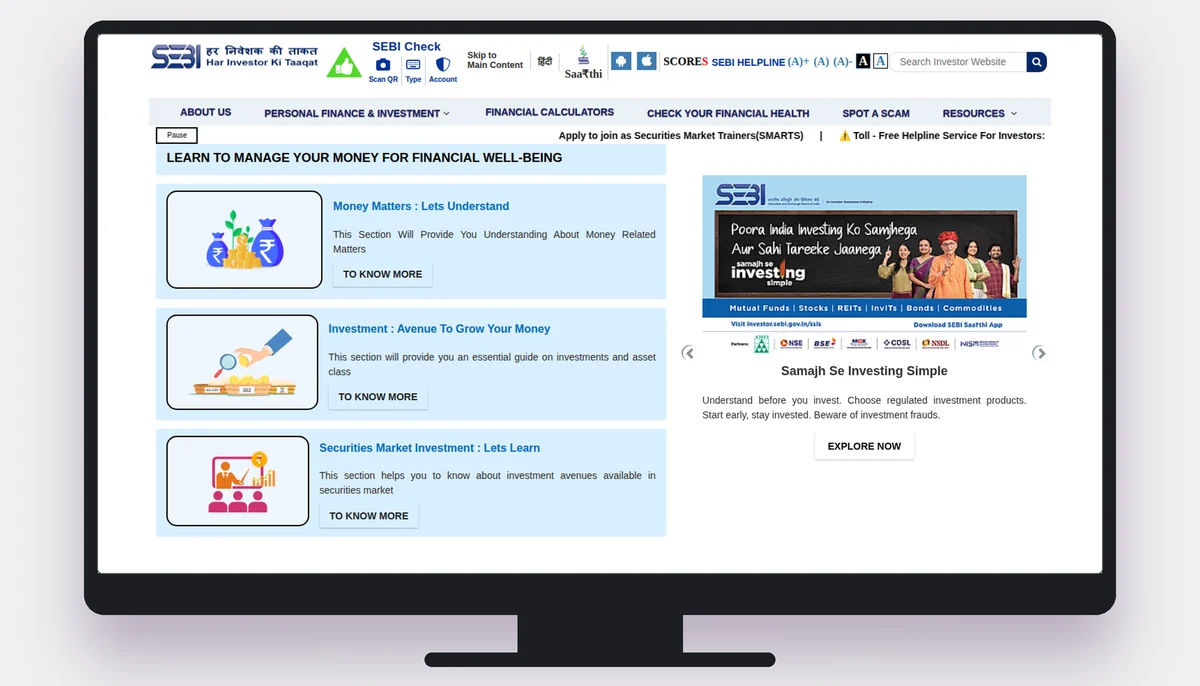
What the regulators publish, and how to read it
- SEBI's investor cautionsHow to read SEBI's public notices about unregistered advisers, bots and apps, and what a caution is not.
- The RBI's Alert ListWhat the Reserve Bank's list of unauthorised forex platforms records, and the permitted route under the law.
- AI bots and signal appsWhy a bot's claim cannot be verified from outside, and what a registered adviser offers instead.
- Check a registered intermediaryHow to search SEBI's list, read the validity field and compare contact details before you act.
- Forex under FEMAThe general position on resident forex trading: recognised exchanges in rupee pairs, not overseas margin platforms.
- Where to complainThe channels for a complaint about a registered entity, a regulated entity, a cyber fraud or a payment.
SEBI cautions to investors, newest first
Each row is a press release in which SEBI cautioned investors, under SEBI's own title and date. A caution describes a practice; it is SEBI's act, not this site's verdict.
| Caution as SEBI titled it | Published | Kind | Source |
|---|---|---|---|
| October 2026 | |||
| Caution to Investors against Stock Tips offered through Invitation-only WhatsApp Groups | 22.10.2026 | Caution to investors | SEBI ↗ |
| August 2026 | |||
| Caution to Investors regarding display of Live trading strategies on Social Media Platforms | 17.08.2026 | Caution to investors | SEBI ↗ |
| July 2026 | |||
| Caution to Regulated entities and listed companies- Boss Scam | 17.07.2026 | Caution to investors | SEBI ↗ |
| February 2026 | |||
| Caution to Investors on Stock Market Scams through Account Handling Services | 26.02.2026 | Caution to investors | SEBI ↗ |
| Caution to the Public regarding fake STT notices | 26.02.2026 | Caution to investors | SEBI ↗ |
| November 2025 | |||
| Caution to public regarding dealing in ‘Digital Gold’ | 08.11.2025 | Caution to investors | SEBI ↗ |
| Caution to Public regarding unregistered Online Bond Platform Providers | 19.11.2025 | Caution to investors | SEBI ↗ |
| September 2025 | |||
| Caution to the public regarding impersonation of SEBI | 05.09.2025 | Caution to investors | SEBI ↗ |
| August 2025 | |||
| Advisory Against investment in Fraudulent Trading Schemes claiming to be offered to Indian residents by FPIs | 22.08.2025 | Caution to investors | SEBI ↗ |
| June 2025 | |||
| Caution to Public | 04.06.2025 | Caution to investors | SEBI ↗ |
| May 2025 | |||
| Caution to Investors on Stock Market Scams through Social Media Platforms | 21.05.2025 | Caution to investors | SEBI ↗ |
| Caution to investors SEBI accepts surrender application of Strata SM REIT | 14.05.2025 | Caution to investors | SEBI ↗ |
| April 2025 | |||
| Caution to public against dealing on ‘Opinion Trading Platforms’ | 29.04.2025 | Caution to investors | SEBI ↗ |
| Caution to public against Fraudulent / Manipulative activities on Social Media Platforms (SMPs) related to securities market | 11.04.2025 | Caution to investors | SEBI ↗ |
| December 2024 | |||
| Caution to Public | 05.12.2024 | Caution to investors | SEBI ↗ |
| November 2024 | |||
| Advisory on unauthorized virtual trading / gaming platforms | 04.11.2024 | Caution to investors | SEBI ↗ |
| February 2024 | |||
| SEBI cautions public against dealing with unregistered entities | 13.02.2024 | Caution to investors | SEBI ↗ |
| SEBI Issues Advisory Against Fraudulent Trading Schemes claiming to be offered to Indian residents by FPIs | 26.02.2024 | Caution to investors | SEBI ↗ |
Source: SEBI — Press releases
A SEBI caution is not a customer complaint
A caution from SEBI is an official notice that a person or platform appears to be offering investment services without the registration the law requires. It is not a record of a consumer dispute, and it does not mean that anyone has been convicted or ordered to stop. The caution is a public warning, issued after the regulator sees material that suggests a possible breach.
The notice often asks investors to report if they have dealt with the named entity, but it does not itself open a refund process. A person who has lost money still has to follow the usual routes for complaints, whether with the police, a consumer forum, or a court. The caution can be used as background, but it does not decide the dispute.
Treat the caution as a flag that the regulator has taken note of a name or a method. It may be the first step in a longer enforcement chain, or it may never go further. The important point for an app user is that the caution removes any excuse for not knowing that the service was unregistered at that date.
A registered intermediary can still sell you a bad product
Checking a registration on the SEBI website tells you that the person or firm is allowed to give investment advice or manage funds, not that their advice is good. A registered adviser can recommend a poor strategy, charge high fees, or ignore your risk profile. Registration is a licence to operate, not a guarantee of quality or profit.
What registration does give you is a supervisor. If a registered adviser misleads you, you can complain to SEBI and the adviser has to answer. With an unregistered person, the regulator has no direct handle, and you may be left with only a criminal complaint. The registered route gives you a paper trail and a set of rules the adviser must follow.
So do not read a registration as a seal of approval. It is a filter that removes the most obvious risk, the risk that the person is not allowed to advise at all. After that, you still have to judge the advice on its merits, and you still carry the loss if the investment fails.
A signal app's fee is not the only cost you pay
When a signal app charges a monthly subscription, that is the visible cost. The hidden costs come from the trades themselves. Every buy or sell you make pays brokerage, taxes, and a spread. If the signal turns out to be late or wrong, you pay those costs on a trade that should not have happened.
Some signal apps earn a commission from the broker when you trade through their link. That means the app has an incentive to send you more signals, not better signals. The more you trade, the more the app earns, regardless of your result. This conflict is rarely disclosed.
Before you follow a signal, ask who pays the app. If the only payment is your subscription, the app has an interest in keeping you subscribed. If the app also gets a cut from the broker, the interest is in making you trade often. Neither payment model makes the signal accurate, but one of them makes the cost of a bad signal much higher.
A caution from SEBI does not stop the named entity from taking new clients
When SEBI publishes a caution naming an unregistered adviser or platform, the text often says investors should not deal with it. That sentence is advice to the public, not an order to the entity. The entity may keep its website running, keep its app in the store, and keep taking payments from new users on the same day the caution appears.
The regulator's power to freeze an entity's operations comes through a separate process, such as an interim order or a direction after a hearing. A caution is usually the first public step. Until a formal order is passed, the entity is not barred from soliciting clients, and the caution itself does not instruct banks or app stores to block it.
For a reader, this means a caution should change what you do next, but it does not mean the problem has been removed. The entity may still contact you, run advertisements, or onboard your friends. A cautious investor treats the caution as a signal to stop and verify, not as proof that the entity has been shut down.
The RBI Alert List does not tell you which platforms are safe for forex trading
The Alert List names platforms that the RBI says are not authorised for forex transactions under the Foreign Exchange Management Act. It is not a list of approved platforms. A name absent from the list does not mean the platform is permitted. The list only flags entities the RBI has identified as unauthorised.
A resident who wants to trade currency derivatives has a narrow legal route: through a recognised stock exchange, using a broker registered with SEBI. No overseas app offers that route. The absence of an app from the Alert List simply means the RBI has not yet named it, not that the app complies with Indian law.
Some readers assume that checking the list is enough to decide if a platform is safe. That assumption is wrong. The list is a warning instrument, not a certification system. To know whether a platform is authorised, a resident must check the exchange and broker registrations, not the Alert List.
A bot that claims to use AI cannot show you the rule behind its trade calls
A trading bot that says it uses artificial intelligence typically produces buy or sell signals from a model it does not disclose. The user sees the signal, not the reasoning. The bot cannot show the exact rule that triggered a call, because the model is often a black box even to its developer.
This matters because a registered investment adviser in India is required to explain the basis of advice when asked. A bot operating without registration has no such duty. It can change its model, feed it different data, or stop working altogether, and the user has no way to audit what happened.
When a bot gives a signal, the user assumes the risk of acting on it. The bot does not become responsible for the loss. If the signal was generated by an unregistered entity, the user also loses the regulatory recourse that comes with a registered adviser.
A signal app can keep you paying even after the regulator has named it
When SEBI publishes a caution about a signal app, the app does not disappear from the app store. Users who have already paid for a subscription or a bot still receive messages, because the caution by itself does not cut off the app's revenue. The app may continue to send buy and sell calls, and the chat group may stay active. What changes is the regulator's visible position: the entity is now on record as unregistered for the activity it is doing.
The practical consequence lands on the person who keeps following those signals. If the trades go wrong, the user cannot say the regulator had not warned them, because the caution is dated and public. The loss is then not just the money lost on a trade but the fact that the warning was available and ignored. This does not make the app's calls wrong, but it shifts the responsibility for continuing to act on them onto the user.
The more dangerous pattern is when the app uses the caution itself as a marketing hook. Some groups tell users that SEBI is trying to protect big brokers and that the app is being targeted because it is good. That is a story, not a fact. The caution is about registration status, not about whether the signals work. A reader who treats the caution as a badge of honour has read it backwards.
What opening an account with an international broker means
The account this site links to is with FxPro, an international broker offering CFDs on currencies, metals, indices, shares and crypto. A CFD is an agreement on a price; no asset is delivered. CFDs are leveraged and carry a high risk of losing the money deposited. Before opening an account from India, check the current rules on remittance with an authorised bank.