
AI trading bots and signal apps
Key facts
An AI trading bot or signal app claims to make trading decisions for you. The claim cannot be verified from outside the app. Unregistered advisory is what SEBI's cautions concern. A registered investment adviser or research analyst is a different, checkable category. This page explains the difference in words, not numbers.
What a bot claims
A bot claims to use artificial intelligence to generate trading signals or to execute trades automatically. The claim is that the bot can analyse market data and make profitable decisions faster than a human. The bot may also claim to learn from its own trades and improve over time.
These claims cannot be verified from outside the app. The bot's code is not public, its past performance is not audited, and its results are not independently reported. A reader has no way to know whether the bot's claims are true.
Why the claim cannot be verified
A bot's performance depends on the data it receives, the rules it follows, and the market conditions it faces. None of these are visible to a reader. The app may show a backtest or a live performance record, but that record is produced by the bot itself and is not audited by an independent party.
A registered investment adviser or research analyst is different. That person or firm must disclose its performance, its fees and its conflicts of interest in a standard format. A reader can check the registration number on SEBI's list and read the disclosures.
Unregistered advisory is what SEBI cautions
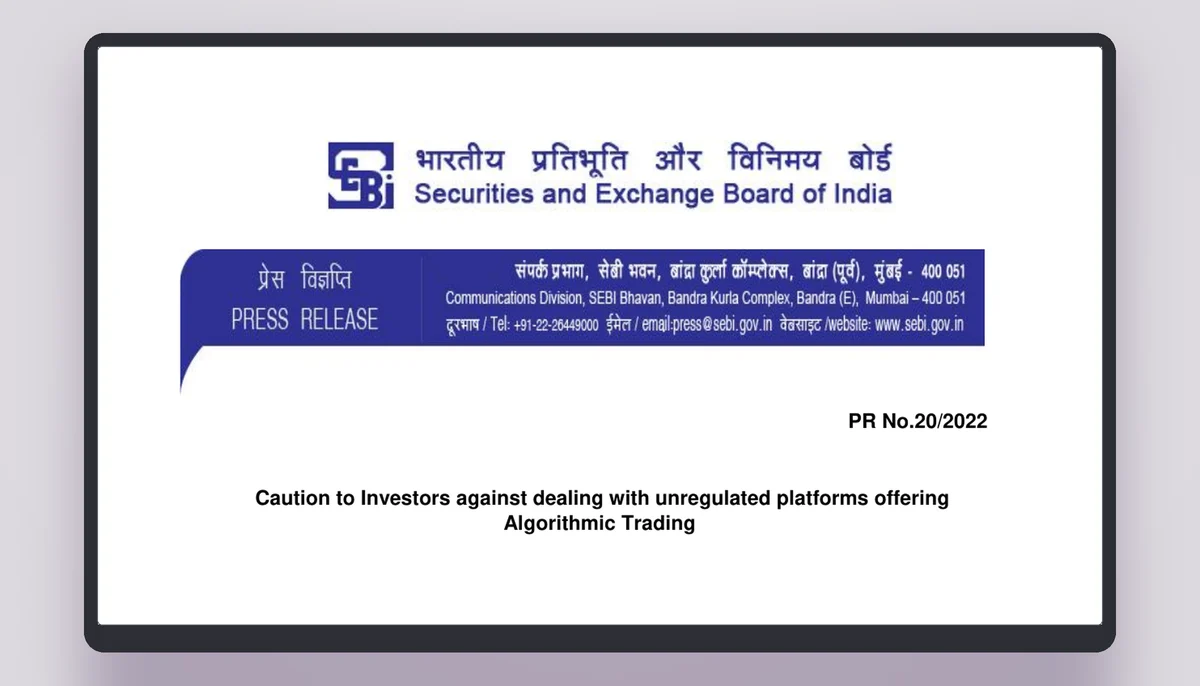
SEBI's cautions often name apps and bots that are offering investment advice without registration. The caution says that the app is not registered and that investors should not deal with it. The caution does not say that the bot is a fraud; it says only that it is unregistered.
An unregistered bot cannot legally offer investment advice to Indian residents. If a bot is offering advice, it must be registered as an investment adviser. If it is offering research, it must be registered as a research analyst. A bot that does neither is outside the law.
What 'registered' lets you verify
A registered investment adviser or research analyst has a registration number on SEBI's list. The list shows the name, the registration number, the validity period and the contact details. A reader can search the list by name or number and compare the details with the ones in the app.
A registration is a permission with a validity period. It is not a guarantee of performance. But it lets you verify that the person or firm is allowed to offer the service it claims to offer. That is the first check.
The cost of an unverified claim
If a bot's claim is false, the reader loses the money paid for the bot or the losses from its trades. If the bot is unregistered, the reader has no regulator to complain to. SEBI's complaints process is for registered entities; an unregistered bot is outside that process.
The reader may still complain to the cybercrime authorities or to the bank, but recovery is uncertain. The best protection is to check the registration before paying any money.
What to ask before using a bot
Ask for the registration number and the name of the registered entity. Check that number on SEBI's list. Compare the contact details on the list with the ones in the app. If the details do not match, do not proceed.
Ask for the bot's performance record, audited by an independent party. Ask for the fees and the conflict of interest disclosures. If the app will not provide these, that is a warning sign. A registered adviser must provide them.
A bot cannot show you its live trading decisions
The moment a bot claims it has made profitable trades, you are being asked to believe a record that no outside authority has checked. A bot can display a dashboard with green numbers, but those numbers are generated by the same system that executed the trades. There is no independent log that a reader can inspect.
A registered adviser is required to keep records that a regulator can ask to see. A bot seller faces no such requirement. That is the practical difference: one claim is auditable by a third party, the other is not.
When a bot shows you a backtest, that is a simulation on past data. Even if the simulation is honest, it does not tell you what the bot will do with live money. The past data is fixed; the live market is not.
Signal apps often hide how the signal is produced
A signal is a suggestion to buy or sell at a particular time. The app may say the signal came from an algorithm, but it rarely shows the code or the data that produced the signal. You are left with only the assertion that the algorithm knows something you do not.
If the signal fails, the app can blame the market. If the signal succeeds, the app can take credit. There is no way for you to distinguish skill from luck because you cannot see the process that generated the signal.
A registered adviser has to explain the basis of a recommendation when asked. An unregistered signal app does not have that obligation. The asymmetry in information is the core of the problem.
Unregistered bots often take a cut of your trading volume
Many bot services earn money when you trade, not when you profit. The bot may be connected to a broker that pays a rebate for every order the bot places. The more the bot trades, the more the service earns, regardless of whether you make money.
This creates an incentive to churn your account. The bot may place trades more frequently than a human would, simply because each trade generates a small fee for someone else. Your portfolio may suffer from transaction costs that eat into any gains.
A registered adviser typically charges a fixed fee or a fee based on assets under advice, not on the number of trades you place. The difference in compensation changes the advice you receive.
SEBI's caution covers bots that give a buy or sell call
The Securities and Exchange Board of India has said that any person who gives investment advice to the public must be registered. A bot that tells you to buy a particular stock or to sell a particular contract is giving investment advice. The fact that the advice comes from software does not change the legal character of the act.
SEBI's caution is not limited to human advisers. It includes any unregistered service that offers trading tips, stock recommendations, or portfolio management, whether delivered by a person or by an algorithm.
When you use an unregistered bot, you are relying on a service that has not agreed to the rules that registered advisers must follow. Those rules include maintaining records, avoiding conflicts of interest, and being fit and proper.
A registered adviser has to tell you about conflicts
A registered investment adviser must disclose any conflict of interest to the client. That includes any payment the adviser receives from a product manufacturer, a broker, or any other party. The disclosure has to be in writing and given before the advice is provided.
An unregistered bot seller has no such obligation. The bot may be earning a commission from a broker while telling you it is acting in your interest. You would never know because there is no disclosure document.
The disclosure requirement is one of the few concrete protections you get from registration. It does not guarantee good advice, but it forces the adviser to reveal who is paying them, which is more than an unregistered service will do.
The cost of a wrong signal is not just the loss on the trade
When a bot gives a bad signal, you lose money on the trade. But the loss does not stop there. You may also pay brokerage, securities transaction tax, and other charges. Those costs are incurred whether the trade makes money or loses money.
If the bot trades frequently, those costs compound. A strategy that loses a small amount on each trade can still drain a significant sum over time because of the transaction costs alone. The bot seller does not bear those costs; you do.
A registered adviser is required to consider your overall financial situation and to recommend a strategy that is suitable for you. An unregistered bot has no such duty. The bot may recommend trades that are unsuitable for your risk profile or your financial goals.
A bot's past trades are usually a statement about its owner, not about you
When a seller shows you a streak of winning trades from an AI bot, those trades happened on someone else's account, with a different starting balance and at times when market conditions were not the same as yours. The seller controls which trades to show and which to leave out. A losing week, a margin call or a forced exit can simply be omitted from the screenshot. No independent record exists for you to cross-check.
What is being advertised is not a repeatable sequence. The bot may have taken trades that depended on the exact price at the exact second, the liquidity available on that particular platform, or the leverage offered to that particular account. Your order may be filled at a worse price, or not filled at all. The past performance is not a promise about what happens next.
A registered adviser faces a different set of expectations. Their advice is supposed to be suitable for the client's stated risk profile and financial situation, not a claim about what a machine did before. The distinction matters because a bot's history tells you only what its owner chose to reveal, while a registered adviser's suitability assessment is a process you can ask to see.
The signal that arrives late has already been paid for by someone else
A signal app sends a message telling you to buy or sell a share or a currency pair. By the time that message reaches your phone, the price has moved. The person who generated the signal, or the bot that scanned the market, has already acted or has already told a paying group before you. You are receiving the information after the most valuable moment has passed.
The delay is not just about seconds. Some signal services charge more for a faster tier, which means the free or cheaper users are deliberately placed at the back of the queue. The consequence is that you may be entering a trade at a price that already reflects the signal itself. The profit that was possible at the moment of generation is no longer available to you.
A registered investment adviser does not operate this way in the Indian regulatory framework. The advice is supposed to be given to you based on your circumstances, not broadcast to a list in order of payment. Asking a signal provider to show the timestamp of the original call and the timestamp of your receipt can reveal how much of the move you missed.
When the bot trades for you, the person responsible for the loss is not the bot
An AI trading bot that places orders on your behalf through your own brokerage account leaves you with the legal and financial consequences of every trade. The bot has no money of its own to lose and no registration number to suspend. If the strategy fails, the loss is taken from your funds, and the margin shortfall is your debt to the broker.
The seller of the bot typically disclaims responsibility for trading outcomes in the terms of service. The software is provided 'as is', and the user agrees that market risk is borne entirely by the user. Even if the bot malfunctions, places duplicate orders, or fails to exit a position, the practical route to recover anything is limited. The entity that sold the bot may be difficult to reach or may have no presence in India.
This is different from giving discretionary authority to a registered portfolio manager. A registered portfolio manager is accountable to SEBI for how the client's funds are handled, and the client has a documented agreement that sets out what the manager can and cannot do. A bot's terms of service, by contrast, are written to protect the seller, not the user.
Read next
What users of trading apps ask
What is an AI trading bot?
An AI trading bot is an app that claims to use artificial intelligence to generate trading signals or to execute trades automatically. Its claims cannot be verified from outside the app.
Is a bot registered with SEBI?
Most bots are not registered. SEBI's cautions often name bots and apps that are offering investment advice without registration. A registered investment adviser or research analyst has a registration number on SEBI's list.
Can I trust a bot's performance record?
No. The performance record is produced by the bot itself and is not audited by an independent party. A registered adviser must disclose its performance in a standard format, but a bot does not.
What should I check before using a bot?
Check the registration number on SEBI's list. Compare the contact details. Ask for an audited performance record and the fees. If the app will not provide these, do not proceed.
What if I have already paid for a bot?
Gather all records of your dealings. If the bot is unregistered, you may complain to the cybercrime authorities or to your bank. Recovery is uncertain. This site does not give advice on recovery.
What opening an account with an international broker means
The account this site links to is with FxPro, an international broker offering CFDs on currencies, metals, indices, shares and crypto. A CFD is an agreement on a price; no asset is delivered. CFDs are leveraged and carry a high risk of losing the money deposited. Before opening an account from India, check the current rules on remittance with an authorised bank.